

Blog · May 2, 2026
Hot Tub Removal Service: What to Expect
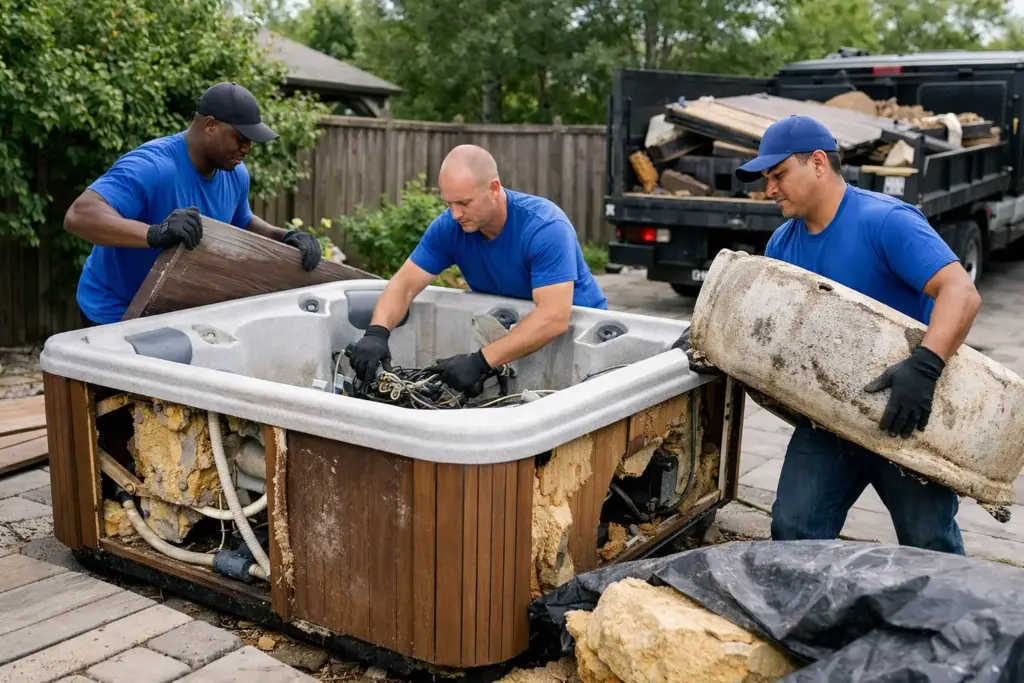
That dead hot tub in the backyard usually starts as a “we’ll deal with it later” problem. Then later turns into a cracked shell, a busted pump, a mosquito hotel, and one more giant thing taking up space. A good hot tub removal service solves that fast, but not every removal job is priced or handled the same way.
If you’re looking at an old spa and wondering whether this is a simple pickup or a full-blown teardown, the answer is: it depends on access, size, and weight. Some tubs can be rolled out in sections. Others need to be cut apart on site, hauled through a gate, and loaded piece by piece. The right crew makes it look easy. The wrong plan turns into a weekend of sweat, dump runs, and regret.
When a hot tub removal service makes sense
There are a few clear signs it’s time to stop working around the tub and get it gone. Maybe it no longer heats, leaks constantly, or trips the breaker every time you try to use it. Maybe you bought a home with one already sitting there and have zero interest in becoming a part-time spa technician.
Removal also makes sense when the tub is blocking a bigger project. Deck repairs, patio upgrades, landscaping work, fence replacement, and home sales all get easier when the old hot tub is out of the picture. For landlords and property managers, it can be one less liability sitting empty between tenants.
Some people ask whether donating or reselling the hot tub is a better move. Sometimes, yes. If it’s newer, fully functional, and accessible, someone may want it. But a lot of older units have hidden issues, and moving them costs money even when they’re free. Once a tub stops being an asset, hauling it away is usually the cleaner answer.
What affects hot tub removal cost
Price is rarely about the tub alone. It’s about the work required to get that tub from where it sits now to a truck.
Size matters, of course. A compact two-person spa is a different animal than an oversized eight-person unit with a heavy cabinet and thick shell. Weight matters too, especially if the tub still has internal components attached or has taken on water damage over the years.
Access is often the biggest factor. If the hot tub sits next to the driveway with wide-open space, the job is more straightforward. If it’s tucked behind a fence, up a hill, sunk into a deck, or wedged into a screened porch, labor goes up. Tight corners, steps, soft ground, and long carry distances all add time and muscle.
Then there’s demolition. Some tubs can be removed intact, but many can’t. Cutting a hot tub into manageable pieces is common and often the most practical choice. That takes tools, safety gear, cleanup, and experience. If electrical disconnects or partial deck disassembly are involved, that can affect the scope too.
Disposal also plays a role. A professional crew has to sort out what can be recycled, what goes to a transfer station, and what requires special handling. That’s part of what you’re paying for – not just lifting, but the whole removal chain.
How the removal process usually works
A professional hot tub removal service should make the process pretty simple. In most cases, it starts with a few details: the tub size, where it’s located, whether it works, and a couple of photos. Those photos help spot access issues before anyone shows up with big promises and small tools.
On removal day, the crew checks the setup, confirms the price, and decides whether the tub comes out whole or gets cut down on site. If the tub is already disconnected and drained, great. If not, that should be discussed ahead of time so nobody loses time standing around a half-full spa.
Once the crew starts, the goal is controlled removal, not backyard chaos. Panels come off, components may be stripped, the shell may be cut, and debris gets loaded as the work moves along. A good team cleans up after the job instead of leaving behind insulation bits, screws, and busted framing.
For most homeowners, the biggest benefit is not having to coordinate tools, labor, a trailer, and a disposal site. You point at the tub. It goes away. That’s the whole dream.
DIY hot tub removal vs. hiring pros
There is a DIY version of this job. Plenty of people have done it with saws, pry bars, rented trailers, and a few brave friends. If the tub is small, easy to reach, and you’re comfortable cutting it apart safely, DIY can save money.
But this is where trade-offs show up fast. Hot tubs are bulky, awkward, and heavier than they look. Cutting into one can expose wiring, sharp edges, soaked insulation, and stubborn framing. Then you still have to load it, strap it down, drive it somewhere, unload it, and hope the dump accepts what you’ve brought.
Hiring a pro costs more than doing nothing, but usually less than a DIY mistake. If access is bad, the tub is large, or you just want the space back without burning a Saturday, professional removal is usually the better bet.
Questions to ask before you book
Not all junk haulers handle spa removal the same way, so it helps to ask a few direct questions. Do they remove hot tubs regularly? Can they cut it down on site if needed? Is labor included in the quote? What happens if access is tighter than it looks in the photos?
You should also ask about what needs to be done before the appointment. Some companies want the tub fully drained and disconnected ahead of time. Others may handle parts of that process, but it needs to be clear. The last thing you want is a truck in the driveway and a job that can’t start.
Pricing transparency matters too. A solid company should be able to explain what drives the quote without getting slippery about it. Volume, labor, access, and disposal fees are all fair considerations. Surprise charges that appear out of nowhere are not.
Why local service usually works better
A local crew tends to move faster because they know the area, the disposal options, and the kinds of properties they’re walking into. In places around Charlotte, for example, hot tubs might be sitting on decks, tucked into fenced suburban backyards, or parked behind rental homes that need a quick turnover. Local haulers see those setups every day.
That also helps with scheduling. If you need the tub gone before a contractor starts, before family comes in town, or before a house hits the market, response time matters. Same-day or next-day availability can be the difference between progress and a stalled project.
For a company like Junk Punk, this kind of work fits right into the wheelhouse – big item removal, light demo, fast turnaround, and no drama if the tub needs to be cut up where it sits.
What to do before the crew arrives
You do not need to turn this into a major prep project, but a little setup helps. Make sure the tub is drained unless you’ve been told otherwise. Clear a path to the unit if patio furniture, planters, or kids’ toys are in the way. If there’s a gate code, locked fence, or parking issue, mention it ahead of time.
If you’re not sure whether the power is disconnected, say so. Electricity and water are a bad combo, and that is not the kind of surprise anyone wants on removal day. Good communication saves time and keeps the job safe.
A hot tub gone means usable space again
People usually focus on the removal itself, but the real payoff is what happens after. You get your patio back. Your yard looks bigger. That ugly broken shell stops dragging down the whole space. Whether you’re planning a cleaner backyard, prepping a property for sale, or just tired of staring at a giant plastic regret machine, getting it removed is one of those jobs that feels good immediately.
If your hot tub has officially crossed over from luxury item to oversized headache, don’t let it keep squatting in your yard. The right crew can break it down, haul it out, and leave you with something better than junk-free space – momentum.
That dead hot tub in the backyard usually starts as a “we’ll deal with it later” problem. Then later turns into a cracked shell, a busted pump, a mosquito hotel, and one more giant thing taking up space. A good hot tub removal service solves that fast, but not every removal job is priced or handled the same way.
If you’re looking at an old spa and wondering whether this is a simple pickup or a full-blown teardown, the answer is: it depends on access, size, and weight. Some tubs can be rolled out in sections. Others need to be cut apart on site, hauled through a gate, and loaded piece by piece. The right crew makes it look easy. The wrong plan turns into a weekend of sweat, dump runs, and regret.
When a hot tub removal service makes sense
There are a few clear signs it’s time to stop working around the tub and get it gone. Maybe it no longer heats, leaks constantly, or trips the breaker every time you try to use it. Maybe you bought a home with one already sitting there and have zero interest in becoming a part-time spa technician.
Removal also makes sense when the tub is blocking a bigger project. Deck repairs, patio upgrades, landscaping work, fence replacement, and home sales all get easier when the old hot tub is out of the picture. For landlords and property managers, it can be one less liability sitting empty between tenants.
Some people ask whether donating or reselling the hot tub is a better move. Sometimes, yes. If it’s newer, fully functional, and accessible, someone may want it. But a lot of older units have hidden issues, and moving them costs money even when they’re free. Once a tub stops being an asset, hauling it away is usually the cleaner answer.
What affects hot tub removal cost
Price is rarely about the tub alone. It’s about the work required to get that tub from where it sits now to a truck.
Size matters, of course. A compact two-person spa is a different animal than an oversized eight-person unit with a heavy cabinet and thick shell. Weight matters too, especially if the tub still has internal components attached or has taken on water damage over the years.
Access is often the biggest factor. If the hot tub sits next to the driveway with wide-open space, the job is more straightforward. If it’s tucked behind a fence, up a hill, sunk into a deck, or wedged into a screened porch, labor goes up. Tight corners, steps, soft ground, and long carry distances all add time and muscle.
Then there’s demolition. Some tubs can be removed intact, but many can’t. Cutting a hot tub into manageable pieces is common and often the most practical choice. That takes tools, safety gear, cleanup, and experience. If electrical disconnects or partial deck disassembly are involved, that can affect the scope too.
Disposal also plays a role. A professional crew has to sort out what can be recycled, what goes to a transfer station, and what requires special handling. That’s part of what you’re paying for – not just lifting, but the whole removal chain.
How the removal process usually works
A professional hot tub removal service should make the process pretty simple. In most cases, it starts with a few details: the tub size, where it’s located, whether it works, and a couple of photos. Those photos help spot access issues before anyone shows up with big promises and small tools.
On removal day, the crew checks the setup, confirms the price, and decides whether the tub comes out whole or gets cut down on site. If the tub is already disconnected and drained, great. If not, that should be discussed ahead of time so nobody loses time standing around a half-full spa.
Once the crew starts, the goal is controlled removal, not backyard chaos. Panels come off, components may be stripped, the shell may be cut, and debris gets loaded as the work moves along. A good team cleans up after the job instead of leaving behind insulation bits, screws, and busted framing.
For most homeowners, the biggest benefit is not having to coordinate tools, labor, a trailer, and a disposal site. You point at the tub. It goes away. That’s the whole dream.
DIY hot tub removal vs. hiring pros
There is a DIY version of this job. Plenty of people have done it with saws, pry bars, rented trailers, and a few brave friends. If the tub is small, easy to reach, and you’re comfortable cutting it apart safely, DIY can save money.
But this is where trade-offs show up fast. Hot tubs are bulky, awkward, and heavier than they look. Cutting into one can expose wiring, sharp edges, soaked insulation, and stubborn framing. Then you still have to load it, strap it down, drive it somewhere, unload it, and hope the dump accepts what you’ve brought.
Hiring a pro costs more than doing nothing, but usually less than a DIY mistake. If access is bad, the tub is large, or you just want the space back without burning a Saturday, professional removal is usually the better bet.
Questions to ask before you book
Not all junk haulers handle spa removal the same way, so it helps to ask a few direct questions. Do they remove hot tubs regularly? Can they cut it down on site if needed? Is labor included in the quote? What happens if access is tighter than it looks in the photos?
You should also ask about what needs to be done before the appointment. Some companies want the tub fully drained and disconnected ahead of time. Others may handle parts of that process, but it needs to be clear. The last thing you want is a truck in the driveway and a job that can’t start.
Pricing transparency matters too. A solid company should be able to explain what drives the quote without getting slippery about it. Volume, labor, access, and disposal fees are all fair considerations. Surprise charges that appear out of nowhere are not.
Why local service usually works better
A local crew tends to move faster because they know the area, the disposal options, and the kinds of properties they’re walking into. In places around Charlotte, for example, hot tubs might be sitting on decks, tucked into fenced suburban backyards, or parked behind rental homes that need a quick turnover. Local haulers see those setups every day.
That also helps with scheduling. If you need the tub gone before a contractor starts, before family comes in town, or before a house hits the market, response time matters. Same-day or next-day availability can be the difference between progress and a stalled project.
For a company like Junk Punk, this kind of work fits right into the wheelhouse – big item removal, light demo, fast turnaround, and no drama if the tub needs to be cut up where it sits.
What to do before the crew arrives
You do not need to turn this into a major prep project, but a little setup helps. Make sure the tub is drained unless you’ve been told otherwise. Clear a path to the unit if patio furniture, planters, or kids’ toys are in the way. If there’s a gate code, locked fence, or parking issue, mention it ahead of time.
If you’re not sure whether the power is disconnected, say so. Electricity and water are a bad combo, and that is not the kind of surprise anyone wants on removal day. Good communication saves time and keeps the job safe.
A hot tub gone means usable space again
People usually focus on the removal itself, but the real payoff is what happens after. You get your patio back. Your yard looks bigger. That ugly broken shell stops dragging down the whole space. Whether you’re planning a cleaner backyard, prepping a property for sale, or just tired of staring at a giant plastic regret machine, getting it removed is one of those jobs that feels good immediately.
If your hot tub has officially crossed over from luxury item to oversized headache, don’t let it keep squatting in your yard. The right crew can break it down, haul it out, and leave you with something better than junk-free space – momentum.